
IMARCS Foundation
Read our funder brief

Press releases

The IMARCS Foundation

Pioneering novel research in reef restoration and coastal conservation.

Through innovative marine science practices, with mariculture tanks in Japan, field sites in Micronesia and Belize, a partner lab in Spain, and research leadership in Canada.

Proud member

World Ocean CouncilGlobal Fund for Coral Reefs

Lab access

Universitat de Barcelona

Field partner

Seal of the Government of the Federated States of MicronesiaMicronesia Management and Marketing Enterprises
01 / 16

At a glance

5countries: Japan, Micronesia, Spain, Belize, and Canada
7giant clam species studied: six Tridacna species and Hippopus hippopus
4 + 5mangrove species and main coral types in our work
60research and stewardship articles on our site, plus 8 guest articles and 3 podcast appearances to date
2free curriculum units for grades 5 to 8, requested by 7 high schools and junior colleges

Guest articles on

Stanford UniversityOregon State UniversityBlue Frontierreefs.comEco-Business
02 / 16

Why giant clams are at the center of our work

Every species is threatened
All giant clam species are threatened, and many reefs have lost theirs to overharvesting.
They build habitat for the reef
Giant clams provide habitat structure, contribute to nutrient cycling, and support reef calcification. Each clam is a microhabitat of its own.
They carry the algae corals lose
Giant clams host zooxanthellae, the same symbiotic algae bleached corals have lost. That link drives our coral research.
They filter the water around them
We're exploring giant clams as natural filters for microplastics.
They can be grown out and returned
We grow clams out in our mariculture tanks to reseed reefs where wild populations have declined.
03 / 16

Programs built around open questions

Can giant clams help bleached corals recover?

Testing whether zooxanthellae from giant clams can speed the recovery of bleached corals.

Micronesia, Spain

Turning giant clams into carbon sinks

Testing whether raising seawater pH above 8.5 tips clam shell formation from carbon neutral to a true carbon sink.

Japan

Giant clams as microplastic filters

Exploring clams as natural filters for microplastics, and growing them out to reseed reefs.

Japan

Mangrove conservation

Evaluating mangrove conservation for its carbon sequestration potential and biodiversity impacts.

Belize

The first captive-reared carpet anemones

We've spawned S. haddoni in captivity and are working to rear the larvae to juveniles.

Japan

Rearing flowerpot coral

Rearing Goniopora for conservation and potential medical research.

Japan

A clownfish genomic study

An ongoing genomic study of our breeding pairs and their offspring.

Japan

See all current research

imarcs.org/current-research

04 / 16

Giant clams, corals, and carbon

Carbon sinks Japan

Under natural conditions, giant clam shell formation is roughly carbon neutral, because CO₂ released during calcification offsets carbon uptake. We're testing whether raising seawater pH to levels typical of reef flats (8.5 or higher) can tip that balance and turn clams into true carbon sinks.

Microplastic filtration and reef reseeding Japan

We're exploring giant clams as natural filters for microplastics, and growing clams out in our mariculture tanks to reseed them onto reefs.

Coral bleaching recovery Micronesia, Spain

Using samples collected in Micronesia and our University of Barcelona lab, we're testing whether zooxanthellae from giant clams can improve the thermal tolerance of corals and speed the recovery of bleached corals.

05 / 16

Mangrove conservation in Belize

Mangroves sequester at least five times more carbon than tropical forests. They're also hotspots for biodiversity and key enablers of coral reef health, with many reef species using mangrove root systems as nurseries.

We're evaluating ongoing mangrove conservation activities in Belize, with specific attention to their carbon sequestration potential and biodiversity impacts.

Red, black, white, and buttonwood mangroves

06 / 16

Captive breeding and rearing in Japan

Clownfish

Our breeding pairs anchor school visits and our free classroom curriculum, and an ongoing genomic study of the pairs and their offspring. Every pair we breed takes pressure off wild collection.

Carpet anemone, S. haddoni

Nearly every one in the aquarium trade is wild collected. We've spawned it in captivity and are working on settling the larvae and rearing them to juveniles, which to our knowledge hasn't been documented.

Flowerpot coral, Goniopora

Among the most heavily traded corals and one of the hardest to keep. G. columna alone made up about 7.2 million pieces, 18 percent of the coral trade, from 2010 to 2020 under CITES records.

07 / 16

Where we work

Japan

Mariculture tanks

Giant clams, clownfish, carpet anemones and flowerpot coral, and the research built around them.

Micronesia

Kosrae hatchery

Our core field partner, the FSM National Aquaculture Center Kosrae Giant Clam Hatchery, and the clam farmers we work with.

Spain

University of Barcelona

Our partner lab, where samples are processed and analyzed and our genomic work is supervised.

Belize

Mangroves

Evaluating mangrove conservation for its carbon sequestration potential and biodiversity impacts.

Canada

Research leadership

Where our research leadership is based.

Philippines

Semirara Island (planned)

Pilot research mapped out on a giant clam seeding program. Not yet under way.

08 / 16

Our partners

Membership

World Ocean Council

Nonprofit partner member.

Membership

Global Fund for Coral Reefs

IMARCS is a member.
Academic and laboratory research partner

University of Barcelona

Advises IMARCS, supervises our genomic work, and processes our samples.

Field research partner

FSM National Aquaculture Center

Giant clam hatchery in Kosrae, Federated States of Micronesia, run through MMME and led by Martin Selch.

Livestock partner

Sustainable Aquatics

Marine ornamental hatchery in Tennessee supplying broodstock.

Planned pilot, not yet under way

Semirara Mining and Power Corporation

Grow-out monitoring of seeded giant clams on Semirara Island.

09 / 16

Stewardship, not passive preservation

We practice stewardship, not pure preservation: wise use, not passive protection. People are part of the natural world, not separate from it, and ecosystems intended to be protected in isolation are still shaped by everything happening around them.

When a species is farmed and used sustainably, it gains an economic reason to exist, funding for its recovery, and less pressure on wild populations.

10 / 16

Our team

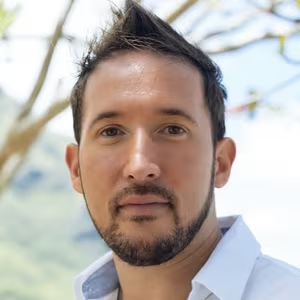
Michael Maddox

Michael Maddox, B.Sc.

President and Head of Life Support

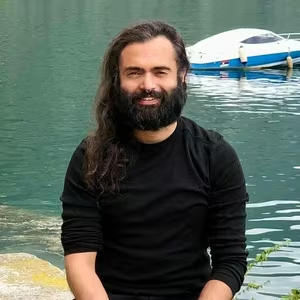
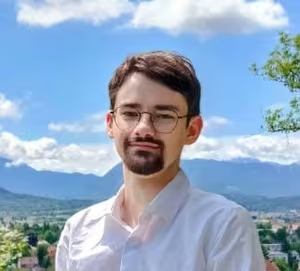
Jordan Flagel

Jordan Flagel, B.A., M.S., M.Sc.

Vice President and Lead Researcher
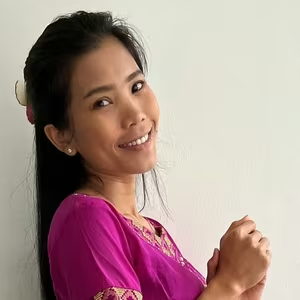
Gui Paphorn

Gui Paphorn, B.A.

Treasurer and Head of Indigenous Outreach
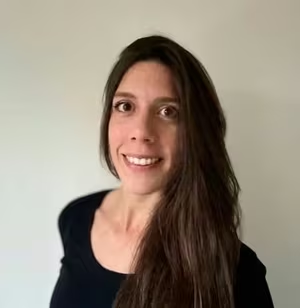
Vanessa Arranz

Vanessa Arranz, Ph.D.

Research Advisor
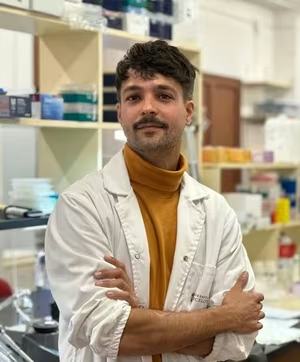
Juan Moles

Juan Moles, Ph.D.

Research Advisor

Lark Aakarshan

Lark Aakarshan

Lead Designer

Tom Birlo

Tom Birlo

Animation and Graphic Design
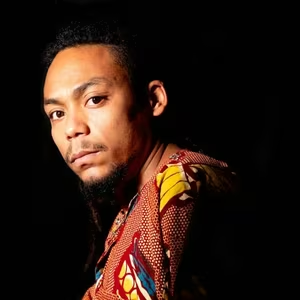
Gary Edwards

Gary Edwards

Photographer and Videographer

11 / 16

Adopt a reef resident at IMARCS

Name it, follow it, and help fund the work that keeps it thriving. Every reef resident lives at our facility in Japan and is part of the research we run there.

Giant clamTridacna
Clownfish pairAmphiprion ocellaris and A. percula
Carpet anemoneStichodactyla haddoni
Flowerpot coralGoniopora spp.

Steward

$15 a month or $180 a year

Ages 13 and up. Monthly photo or video with growth numbers, and a research note.

Family

$19 a month or $228 a year

Kids 2 to 12. A new coloring page and worksheet every month.

Classroom

$29 a month or $348 a year

Classrooms, 4-H clubs, and scout troops. Adds a leader sheet.

Adoption money is earmarked specifically for the reef residents and their care. Adoptions can be given as gifts.

imarcs.org/adopt

12 / 16

A free classroom curriculum

Our curriculum is two units built for grades 5 to 8, free to download. Each unit comes in a standard edition with a verified NGSS crosswalk and a Christian school edition.

Coral Reefs, Giant Clams, and Responsible Stewardship

Clownfish, Sea Anemones, and Responsible Stewardship

Seven high schools and junior colleges have requested them.

imarcs.org/curriculum

13 / 16

Ways to work with us

Press and media

Cover the work or run an angle.

  • Ready-to-run story angles
  • Clam, reef, and mangrove photography
  • Interviews with our scientists
  • Fact-checked, citable language

Brands

Turn purchases into research funding, and get content back.

  • Co-branded blog post and backlink
  • A one-line checkout donation
  • Email receipt and impact page
  • A cause story customers can follow

Creators

Share a mission your audience already cares about.

  • Adoption hooks your audience can act on
  • Short, visual, ready-to-post kits
  • A trackable link so impact is visible
  • Cross-promotion on our channels
14 / 16

Ways a brand can partner

You get content, links, and a cause story that stands apart. IMARCS gets funding, reach, and credibility. We supply a done-for-you kit for each.

15 / 16

Let's build something together

Tell us which lane fits, and we'll send the assets the same week.

Press, brands, creators, and research partners

Jordan Flagel

Vice President and Lead Researcher

science@imarcs.org

Larger or multi-year gifts

Michael Maddox

President

president@imarcs.org